

Shotgun Chokes Explained: Types, Charts and Markings (Cylinder, Improved Cylinder, Modified, Full)
(UPDATED: 2026)
What is the purpose of a choke in a shotgun?
A shotgun choke is a constriction at the muzzle end of the barrel that affects how the shot pattern develops after leaving the barrel.
Different chokes produce different shot patterns, affecting both their spread and density. Choosing the right choke is about finding the pattern that best suits your intended use, ammunition and shooting distance.
Understanding shotgun chokes is useful for many types of shooters – hunters, clay target shooters competing in Skeet and Trap, practical shooting competitors, and even people who buy a shotgun primarily for home defense.
In this guide, we will look at the main types of shotgun chokes, explain how to read choke markings and charts, and take a closer look at the Remington 870, including Rem Choke barrels and interchangeable choke tubes.
⚠️ Shotgun Choke Safety: Real-World Failures
Always check that your choke tube is properly installed and suitable for the ammunition you are using. A loose, damaged, incorrectly installed or incompatible choke can cause serious damage to your shotgun and potentially injure the shooter or people nearby.
These are not hypothetical situations. I have seen several examples of choke tube failures, and the photos below show what can happen when something goes wrong.
1. A Loose Choke Tube That Was Blown Out

Blown-Out Shotgun Choke Tube
This happened to a friend of mine while shooting his Beretta 1301. He had not properly tightened the choke tube before firing. During the shot, the choke was blown out of the barrel and severely damaged.
It is a good reminder to check your choke tube before every shooting session. Never assume it is properly installed just because it was fine the last time you used the shotgun.
2. A Choke Tube Ruptured by Tungsten Shot
In another case, a choke tube was damaged and ruptured while shooting tungsten ammunition. The choke was not designed or rated for that type of shot.
Tungsten ammunition is not automatically compatible with every choke tube. Always check the ammunition manufacturer’s recommendations and the choke manufacturer’s specifications before using this combination.
3. A Choke Tube Deformed by Tungsten Shot
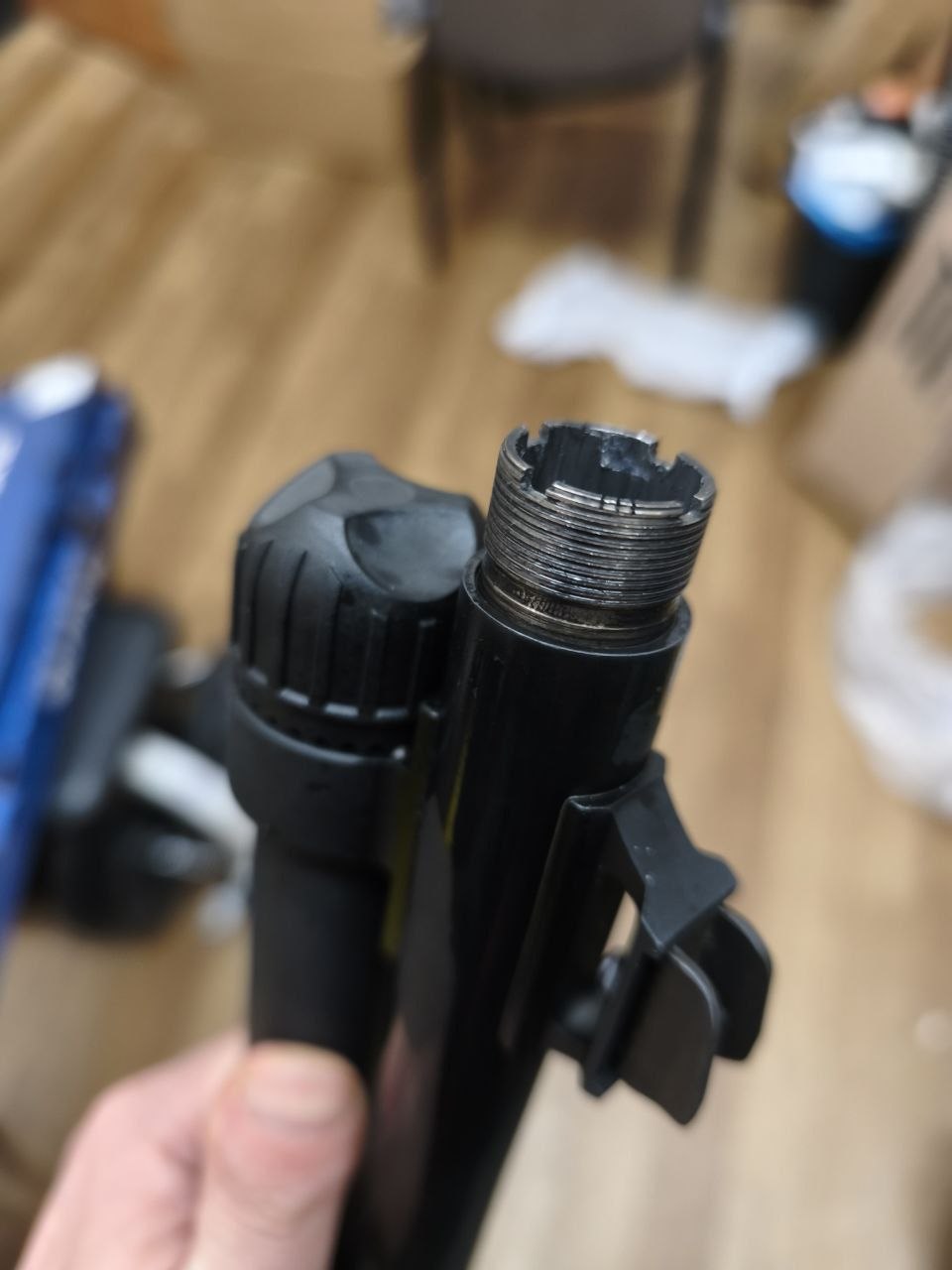
I have also seen a case where tungsten shot caused a choke tube to expand and become stuck in the barrel. It could only be removed using specialized tools, and the choke tube was damaged during removal.
Even when a choke does not visibly rupture, excessive deformation can make it impossible to remove normally and may damage the barrel or choke threads.
4. A Choke Tube Installed Backwards
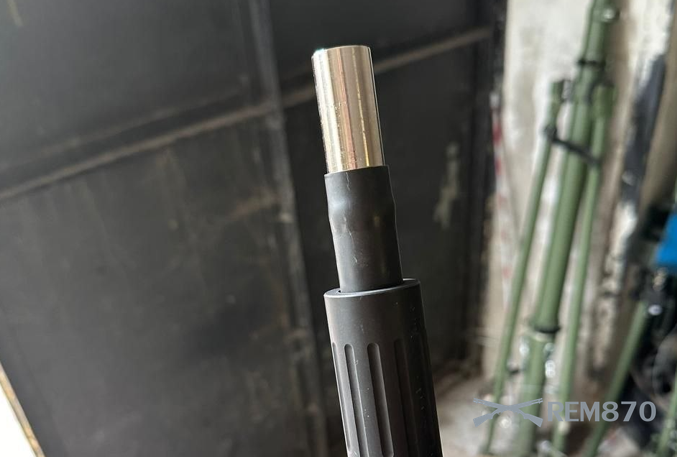
Another example involved a choke tube that had been installed backwards. After firing, the choke was visibly expanded and deformed.
This is a good reason to pay attention not only to whether a choke tube is tight, but also to whether it is correctly installed and compatible with the barrel.
The takeaway is simple: use only the choke tubes specified for your shotgun, follow the ammunition and choke manufacturers’ compatibility recommendations, and inspect the choke before shooting. If you notice deformation, damage, unusual resistance when installing or removing a choke, or any other abnormality, stop shooting and have the shotgun inspected by a qualified gunsmith.
How Different Choke Types Look
There are two main types of shotgun chokes:
- Fixed choke: The constriction is built directly into the barrel and cannot be changed without modifying the barrel.
- Interchangeable (screw-in) choke: A removable choke tube fits into a threaded section at the muzzle and can be replaced with another compatible tube.
Some shotguns come with fixed chokes, while others are designed to use interchangeable choke tubes. It is important to remember that not every shotgun barrel is made for screw-in chokes, and choke tubes are not universal – they must match the barrel’s threading and specifications.
A choke affects the spread and density of the shot pattern produced by a particular shotgun and ammunition combination. Since different loads can produce different results, it is always a good idea to pattern-test your shotgun with the ammunition you plan to use.

Shotgun Choke Types Explained
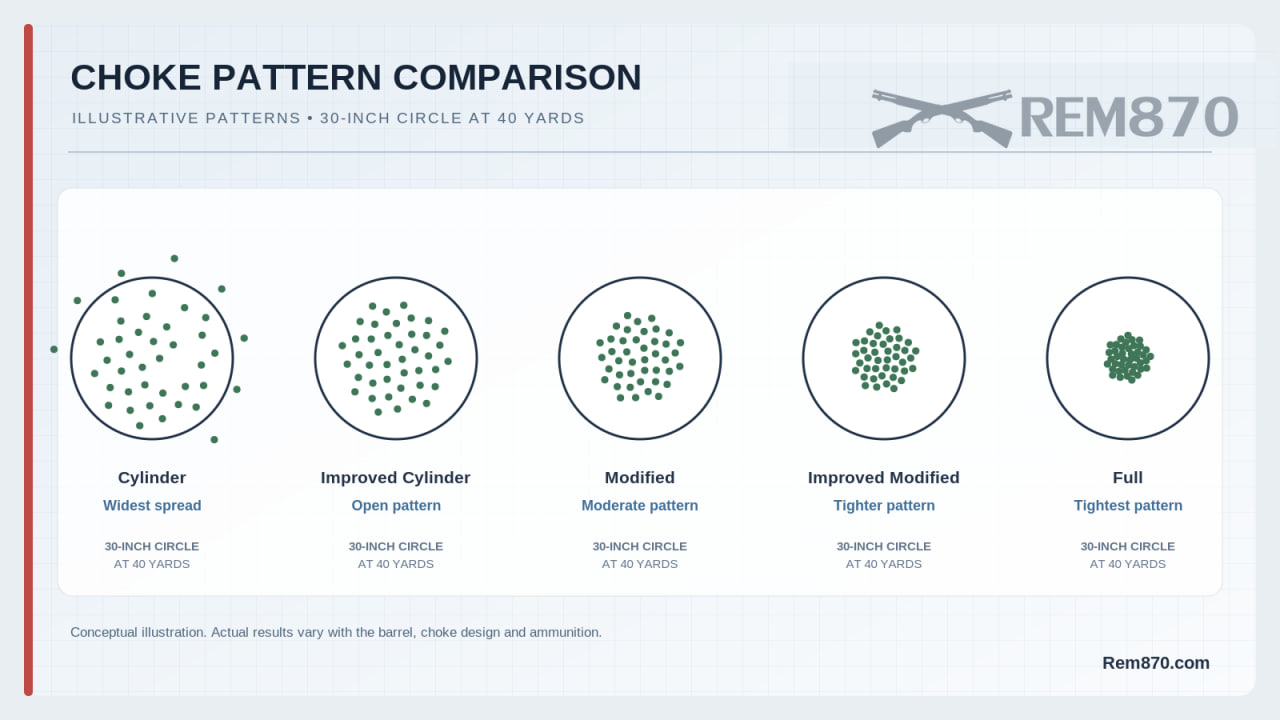
The most common shotgun choke designations are Cylinder, Improved Cylinder, Modified and Full. Other options include Skeet, Improved Modified, Extra Full and Turkey.
These names indicate the relative amount of constriction at the muzzle. However, the exact dimensions and resulting shot patterns can vary between manufacturers and even between different choke designs.
Designing a shotgun choke involves more than simply reducing the diameter of the bore. Factors such as the amount and length of constriction, internal geometry, surface finish and choke material can all influence its performance.
Let’s take a closer look at the most common choke types:
- Cylinder
- Improved Cylinder
- Modified
- Full
Cylinder has little to no constriction and produces a relatively wide shot pattern. It is often used for close-range shooting where a wider pattern is preferred.
Improved Cylinder (IC) has a slight constriction compared to Cylinder. It produces a somewhat tighter pattern while still allowing relatively wide shot distribution.
Modified provides a greater degree of constriction than Improved Cylinder. It produces a tighter pattern and is commonly used for medium-range shooting, including some hunting and clay target disciplines.
Full has a relatively strong constriction and generally produces a denser, tighter pattern at longer distances. It is commonly used in hunting and Trap shooting, where maintaining sufficient pattern density at greater distances is important.
The best choke depends on what you intend to do with your shotgun. Hunters, clay target shooters, practical shooting competitors and people using a shotgun for home defense may all have different requirements.
There is no single choke that works best for every situation. The right choice depends on the shooting distance, target, ammunition and the pattern you want to achieve.

Choke is a constriction
The term choke refers to a constriction in the shotgun bore near the muzzle. It reduces the diameter of the bore compared to the main section of the barrel and influences how the shot spreads after leaving the muzzle.
Some shotguns have fixed chokes, while others are designed to accept interchangeable choke tubes. In the latter case, the choke tube is installed in a threaded section at the muzzle and can be replaced with another compatible tube.
Chokes are often used to produce denser shot patterns at longer distances, which can be useful in hunting and Trap shooting. For home defense, open chokes such as Cylinder or Improved Cylinder are commonly considered, although the appropriate choice depends on the shotgun, ammunition and intended use.
Cylinder and Improved Cylinder are also commonly used with shotgun slugs, but compatibility depends on the specific slug type and the shotgun manufacturer’s recommendations. Always check the ammunition and firearm documentation before using slugs with a particular choke.
Choke tubes are not universal. You cannot assume that a Remington choke tube will fit a Mossberg shotgun or that a Ruger choke will fit a Browning. Some Benelli and Beretta choke systems may share compatibility, but this depends on the specific model, gauge and choke system. Always verify compatibility before installing a choke tube.
Choke tube chart
The illustration below shows the differences between common choke types and how each one affects the resulting shot pattern.
Keep in mind that these illustrations are general examples. Actual patterns depend on several factors, including the shotgun, choke design, ammunition, shot material and shooting distance.
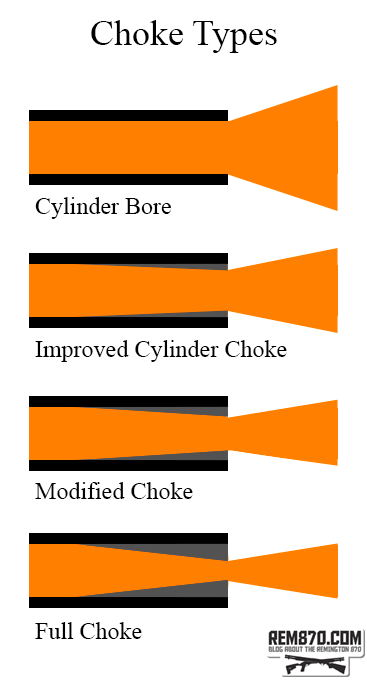
Shotgun Choke Types
The purpose of a choke is to control the spread and distribution of the shot, not simply to make it as tight as possible. A wider pattern may be preferable in some situations, while a denser pattern may be more suitable in others. The only reliable way to see how a particular choke performs with your shotgun and ammunition is to pattern-test it.
One more thing worth knowing: a fixed choke is part of the barrel itself. If you cut off the muzzle section of a barrel with a fixed choke, you will usually remove the constriction as well, leaving a Cylinder-type bore at the new muzzle. This is one reason why modifying a fixed-choke barrel requires careful consideration.
Shotgun Choke Markings
Shotgun choke markings help identify the type of choke installed in the barrel. On interchangeable choke systems, these markings are usually found on the rim of the choke tube. Depending on the manufacturer, they may include letters, numbers, symbols or small notches.
On some shotguns, you can identify the installed choke without removing it. However, the marking system is not the same for every manufacturer, so it is important to know what the markings on your particular choke mean.

12-Gauge 3-Gun Remington Choke Tube Set
Common choke designations include Cylinder, Skeet, Improved Cylinder, Light Modified, Modified, Improved Modified, Full, Extra Full and Turkey. The four most widely used types are Cylinder, Improved Cylinder, Modified and Full.
The table below shows typical choke constrictions, approximate pattern percentages and a commonly used notch identification system.
| Choke | Constriction (inches) | Approx. pattern percentage | Identification (notches) |
|---|---|---|---|
| Cylinder | .000 | 40% | 5 notches |
| Skeet 1 | .005 | 45% | – |
| Improved Cylinder | .010 | 50% | 4 notches |
| Skeet 2 (Light Modified) | .015 | 55% | – |
| Modified | .020 | 60% | 3 notches |
| Improved Modified | .025 | 65% | 2 notches |
| Full | .030 | 70% | 1 notch |
| Extra Full | .040 | 73% | – |
| Turkey | .045+ | 75%+ | – |
Note: These are typical reference values, not universal specifications. Pattern percentages are approximate and generally refer to the percentage of pellets inside a 30-inch circle at 40 yards. Actual results depend on the shotgun, bore dimensions, choke design and ammunition. Constriction measurements and identification markings may also vary between manufacturers.
How to identify a choke by its notches
One common identification system uses notches cut into the rim of the choke tube. In this system, the number of notches indicates the amount of constriction:
- 5 notches: Cylinder
- 4 notches: Improved Cylinder
- 3 notches: Modified
- 2 notches: Improved Modified
- 1 notch: Full
This system is useful, but it should not be treated as universal. Some manufacturers use different markings, and certain choke tubes may have no notches at all. Always check the manufacturer’s documentation before identifying a choke based on its appearance.
Choosing the right choke for your ammunition
Knowing what choke is installed is important, but the marking alone does not tell you exactly how the shotgun will perform.
Different ammunition can produce noticeably different patterns even when fired through the same choke. Shot size, shot material, payload, velocity and the design of the wad can all affect the result.
For example, Cylinder and Improved Cylinder are commonly used with shotgun slugs, but compatibility depends on the type of slug and the manufacturer’s recommendations. Some specialized rifled choke tubes are also available for particular applications. Always check the firearm and ammunition manufacturer’s guidance before using slugs.
Modified and Improved Modified chokes are often used for birdshot and buckshot applications where a denser pattern is desired. Full and Extra Full chokes provide greater constriction and are commonly used for longer-range hunting and certain clay target disciplines.
However, a tighter choke does not automatically guarantee a better pattern or greater effective range. The actual result needs to be checked with the ammunition you intend to use.
If you have several interchangeable choke tubes, it is worth spending some time testing them with different loads. Shoot at a paper patterning target at known distances and compare the distribution of pellets. This will give you a much better idea of how each choke performs in your particular shotgun than relying on its designation alone.
Before shooting, make sure you know which choke is installed and that it is compatible with your ammunition and shotgun. A little time spent understanding the markings and testing different combinations can help you choose the right setup for your intended use.
What is Cylinder Choke?

Cylinder Choke Pattern
A Cylinder choke has no intentional constriction at the muzzle, while an Improved Cylinder (IC) has a slight constriction. Both produce relatively open shot patterns and are commonly used for close-range shooting.
Cylinder and Improved Cylinder chokes are often used with birdshot and buckshot, including applications where a wider pattern is preferred. The actual shot pattern depends on the ammunition used and the shooting distance. Different loads can produce noticeably different patterns even when fired through the same Cylinder choke.
The main difference between these two choke types is the amount of constriction. Cylinder allows the shot to leave the barrel without additional constriction, while Improved Cylinder provides a small amount of constriction. As a result, IC generally produces a slightly tighter pattern, although the difference can vary depending on the ammunition.
Cylinder Choke for Home Defense
Cylinder and Improved Cylinder are commonly considered for shotguns used for home defense. At close distances, a relatively wide shot pattern may provide a greater margin for hitting the intended target compared to a tighter pattern, depending on the ammunition and actual pattern spread.
However, a wider pattern also means a greater risk of hitting someone nearby. This is especially important in situations where other family members, bystanders or hostages may be close to the intended target. Pellets do not distinguish between intended and unintended targets, and even a relatively open choke does not make a shotgun forgiving of poor aim. You must always know what is behind and around your target.
For this reason, it is important to understand how your shotgun and ammunition perform at realistic distances. Pattern testing can show how wide the shot spreads and help you understand the limitations of your setup.
Using Slugs with Cylinder and Improved Cylinder
Cylinder and Improved Cylinder are also commonly used with certain shotgun slugs. However, compatibility depends on the slug design and the shotgun manufacturer’s recommendations. Some specialized rifled choke tubes are also available for particular applications. Always check the ammunition specifications before using slugs with a particular choke.
If you need a tighter shot pattern for longer-range applications, Modified or Full may be more appropriate options. The best choice depends on the intended use and should be confirmed through pattern testing with your shotgun and ammunition.
What is Improved Cylinder choke

Improved Cylinder (IC) has a slight constriction of approximately .010 inches compared to a Cylinder choke, which has no intentional constriction. This small difference generally produces a slightly tighter shot pattern while still allowing relatively wide pellet distribution.
As a general reference, an Improved Cylinder choke may place around 50% of the pellets inside a 30-inch circle at 40 yards when using lead shot. For comparison, a Cylinder choke may produce a pattern of around 40% under similar conditions.
These percentages are only approximate. Actual results depend on the ammunition, shotgun and choke design. Pattern testing is the best way to determine how an Improved Cylinder choke performs with your particular setup.
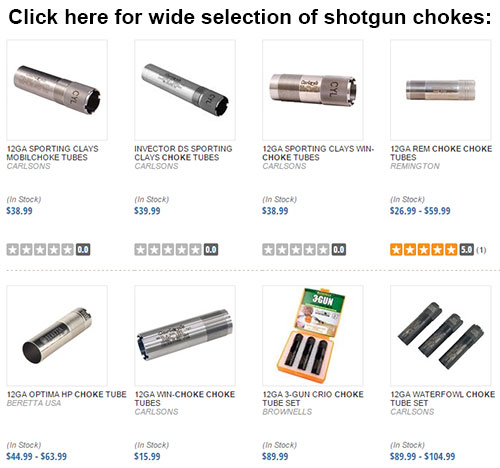
Shotgun Chokes for Remington, Benelli, Beretta, Mossberg, Ruger, Browning, Stoeger
For many shotgun owners, the difference between Cylinder and Improved Cylinder may not be particularly noticeable in everyday use. Both are relatively open chokes, and the better choice depends on the ammunition and intended application.
If your choke tube uses the common notch identification system, an Improved Cylinder is typically marked with four notches on its rim. However, always check the manufacturer’s markings and documentation, as identification systems can vary.
When to use Modified Choke

A Modified choke provides a moderate amount of constriction, typically around .020 inches. It produces a tighter shot pattern than Cylinder or Improved Cylinder, while remaining more open than Full. This makes it a versatile option for situations where a balance between pattern spread and density is needed.
Modified chokes are commonly used for medium-range shooting, including hunting and clay target disciplines. A distance of 30-40 yards is often used as a general reference, although the actual effective range depends on the shotgun, ammunition and the pattern it produces.
As a general reference, a Modified choke may place around 60% of the pellets inside a 30-inch circle at 40 yards when using lead shot. Actual results can vary considerably depending on the load and choke design, so these figures should not be treated as guaranteed performance.
If your choke tube uses the common notch identification system, Modified is marked with three notches on its rim. However, identification markings can vary between manufacturers, so check the manufacturer’s documentation.
Modified chokes can also be used with certain shotgun slugs, but compatibility depends on the slug design and the firearm manufacturer’s recommendations. Do not assume that every slug is suitable for every choke. Always check the specifications of both the ammunition and the shotgun before use.
Full Choke

A Full choke has a relatively strong constriction, typically around .030 inches. It produces a tighter shot pattern than Modified and other more open chokes, helping maintain pellet density at longer distances.
As a general reference, a Full choke may place around 70% of the pellets inside a 30-inch circle at 40 yards when using lead shot. For comparison, a Cylinder choke may produce a pattern of around 40% under similar testing conditions. These figures illustrate the difference in constriction, but actual results depend on the shotgun, choke design and ammunition.
Full chokes are commonly used for hunting and clay target disciplines where a denser pattern at longer distances is desirable. However, the 40-yard measurement is a standard reference for comparing choke performance, not a guaranteed effective range. Some combinations of shotgun, choke and ammunition may produce useful patterns beyond this distance, while others may not. Pattern testing is the only reliable way to determine the practical limits of a particular setup.
Full chokes typically have a constriction of approximately .030 inches. Extra Full and Turkey chokes provide even greater constriction and are designed for more specialized applications. They are not necessarily better choices for general-purpose shooting, as their performance depends on the ammunition and intended use.
For shotguns used for home defense, a Full choke is generally less forgiving than more open options such as Cylinder or Improved Cylinder. Its tighter pattern may leave less margin for error at close distances. Whatever choke is installed, a shotgun must always be aimed carefully, with particular attention to people and objects around and behind the intended target.
As with any choke, the best way to understand Full choke performance is to test it with the ammunition you plan to use and compare the resulting patterns at different distances.
What is Skeet choke?
A Skeet choke is designed to produce a relatively wide shot pattern, making it a popular choice for shooting clay targets at close distances. It is commonly used in the Skeet discipline, where targets are launched from two fixed houses and cross the shooting area at different angles.

Skeet Choke for Shotguns
A typical Skeet choke has a slight constriction, often around .005 inches, although specifications vary between manufacturers. This is slightly more constriction than a Cylinder choke but less than an Improved Cylinder in many common choke systems.
The relatively open pattern is useful for close-range clay target shooting, where shooters need to engage fast-moving targets. Skeet chokes can also be used for certain types of upland bird hunting, depending on the shooting distance and ammunition.
Some shooters prefer extended choke tubes, which protrude beyond the muzzle and are easier to identify and change between stages or shooting sessions. Many models can be initially installed by hand, with final tightening performed according to the manufacturer’s instructions. Extended designs may also feature a longer parallel section, although the actual effect on pattern performance depends on the choke’s internal geometry.
Many modern choke tubes have laser-engraved markings showing the choke designation and constriction. This makes identification easier without having to remove the tube.
Carlson’s Skeet Choke
The Skeet choke I use is made by Carlson’s, a well-known manufacturer of shotgun choke tubes and related accessories.
This particular model is made from 17-4 stainless steel. It features a knurled exterior surface for easier handling, along with wrench flats for installation and removal using a choke tube wrench.
Another useful feature is its compatibility with steel shot. This can be important for shooters who use non-toxic ammunition, including in areas where lead shot is restricted. However, always check the manufacturer’s specifications to confirm that the particular choke is rated for the type and size of steel shot you intend to use.
Overall, this is a well-made choke with practical features for regular use. It is a good option to consider if you are looking for an extended Skeet choke for your shotgun.
Recommended Product:
 Remington Skeet Choke Review |
Get Remington Skeet Choke Review on Brownells |
What is Rifled choke?
A rifled choke is a special type of choke tube with spiral grooves inside its bore. Unlike conventional smooth choke tubes, it is designed to impart some rotation to a compatible shotgun slug as it travels through the tube.

Rifled Choke for Shotguns
Rifled choke tubes are primarily intended for use with smoothbore shotgun barrels. They are often used with sabot slugs, which are designed to work with rifled barrels or rifled choke tubes. The rifling imparts rotation to the slug, which can help improve its stability in flight and potentially improve accuracy compared to using the same ammunition through a smoothbore barrel without rifling.
Results with conventional Foster-type and other rifled slugs can vary. These slugs are already designed to provide stability through their shape and construction, so adding a rifled choke does not necessarily improve their accuracy. Always follow the ammunition and choke manufacturer’s recommendations.
Many rifled choke tubes are extended designs that protrude beyond the muzzle. This makes them easier to install, remove and identify. The extended section also provides some protection for the muzzle, although this is not their primary purpose.
Rifled choke tubes are commonly made from stainless steel, which offers good corrosion resistance and durability. Their internal design, rifling twist rate, dimensions and overall construction vary between manufacturers and models.
Rifled chokes can be useful for shotgun owners who hunt deer or other game with slugs and want to get more from a smoothbore shotgun. However, results depend on the specific shotgun, choke tube and ammunition combination. Testing different compatible slug loads is the best way to determine which combination provides the most consistent accuracy.
For Remington 870 owners, it is important to choose a rifled choke tube specifically designed for the barrel’s choke system and gauge. Not every Remington 870 barrel accepts interchangeable choke tubes, and not all Rem Choke tubes are compatible with every shotgun. Check the manufacturer’s specifications before purchasing or installing one.
Chokes and Slugs
Shotgun slugs are different from birdshot and buckshot. Instead of multiple pellets, a slug is a single projectile designed to travel as one piece. Since it does not produce a traditional shot pattern, choosing a choke for slugs involves different considerations than choosing one for birdshot or buckshot.
The most important factor is compatibility. Not every choke tube is suitable for every type of slug, and you should never assume that a choke that works with birdshot will also be suitable for slugs.
Cylinder and Improved Cylinder are commonly used with many types of shotgun slugs, particularly traditional Foster-style designs. However, the correct choice depends on the slug construction, shotgun barrel and choke manufacturer’s recommendations.
Always check the firearm and ammunition documentation before using slugs. Never assume that a particular choke is safe simply because it has a relatively open constriction.
If you regularly switch between shot loads and slugs, it is also important to verify that the installed choke is suitable for both types of ammunition. Interchangeable choke tubes make it possible to change configurations, but compatibility should always come first.
Rifled Chokes for Slugs
Rifled choke tubes are primarily designed for use with compatible sabot slugs. Their internal spiral grooves impart rotation to the projectile as it passes through the choke, potentially improving its stability and accuracy.
However, results can vary between different shotgun and ammunition combinations. A rifled choke does not guarantee better accuracy, and some shooters may find little difference compared to using a conventional choke with their particular slug load.
For this reason, it is worth comparing the performance of compatible ammunition and choke combinations rather than assuming that a rifled choke will always produce better results.
Rifled choke tubes are generally intended for slug shooting rather than conventional birdshot applications. Their effect on shot patterns can vary, so they should not be considered a general-purpose replacement for standard choke tubes.
What Shotgun Choke Should Be Used for Steel and Tungsten Shot?
Steel and tungsten shot require some additional consideration when choosing a shotgun choke. Unlike lead, these materials have different physical properties, and their compatibility with a particular choke depends on the shot composition, choke design and manufacturer’s specifications.
For steel shot, Cylinder, Improved Cylinder and Modified chokes are commonly used. Some Full chokes are also approved for steel shot, but this should never be assumed. Always check whether the choke and shotgun barrel are rated for the specific type of steel ammunition you intend to use.
Many choke tubes approved for steel shot have an identification marking on the tube, such as “Steel Shot OK”, “Steel”, or a similar designation. This marking indicates that the manufacturer has approved the choke for use with steel shot under specified conditions. However, markings and approval requirements vary between manufacturers. If there is no clear marking, check the manufacturer’s documentation before using steel ammunition. Also make sure that the shotgun barrel itself is suitable for the ammunition you intend to use.
Tungsten shot requires similar attention. There are different tungsten-based shot materials and alloys, and they do not all have the same hardness or density. Some tungsten loads are suitable for conventional choke tubes, while others require specific manufacturer recommendations. A “Steel Shot OK” marking does not automatically mean that a choke is approved for every type of tungsten-based ammunition.
One important difference between steel and lead is density. Steel shot is less dense than lead, which is why hunters often select a larger shot size when switching from lead to steel. Tungsten-based shot, on the other hand, can have a density equal to or greater than lead, depending on its composition.
Do not assume that all non-toxic shot can be used with any choke. Check the ammunition manufacturer’s recommendations and the choke manufacturer’s compatibility information before shooting.
Choke Compatibility
Choke tubes are not universal. Different manufacturers use different threading systems, dimensions and specifications. A choke tube designed for a Remington shotgun will not necessarily fit a Mossberg, Browning, Beretta, Benelli, Ruger or Stoeger.
Even within the same brand, compatibility can depend on the specific model, gauge and barrel configuration. Always check the manufacturer’s compatibility information before purchasing or installing a replacement choke tube.
How to Choose a Shotgun Choke
There is no single best choke for every situation. The right choice depends on the shotgun, ammunition, target, shooting distance and the type of pattern you want to achieve.
A good starting point is to understand the differences between choke types and their constriction. However, the only way to know how a particular choke performs in your shotgun is to test it with the ammunition you intend to use.
Do not assume that a choke with the same designation will produce identical results in different shotguns. Even two barrels of the same model can produce different patterns.
Why Pattern Testing Matters
The actual pattern produced by a shotgun depends on several factors, including the barrel, choke design, ammunition, shot size, shot material, wad design and shooting distance. Different ammunition brands and loads can produce noticeably different results, even when fired through the same choke.
That is why competitive shooters and experienced shotgun owners often test their shotguns using paper patterning targets. There is no single method used by everyone. Some shooters focus on overall pattern distribution, while others count the pellets inside a defined area and compare the results.
A typical pattern test involves shooting at large paper targets placed at known distances. Testing at several distances helps show how the pattern changes as it travels downrange.
After each shot, the target is examined to evaluate the pattern. A commonly used method is to draw a 30-inch circle around the main concentration of pellet holes and count the pellets inside it. The result can then be compared with the total number of pellets in the shotshell to calculate the pattern percentage.
For example, if a shotshell contains 250 pellets and 150 of them land inside the 30-inch circle, the pattern percentage is 60%.
However, the percentage alone does not tell the whole story. It is also important to look at how evenly the pellets are distributed, whether there are large gaps in the pattern and how many pellets are concentrated in the central area.
You can also see examples of paper pattern tests I have conducted in the photos below. They show how different choke and ammunition combinations distribute pellets on target and illustrate why testing your own shotgun is important.
A useful pattern test should help you understand:
- How evenly the pellets are distributed.
- How dense the pattern is in the central area.
- Whether there are significant gaps in the pattern.
- How the pattern changes at different distances.
- How different ammunition loads perform with the same choke.
For meaningful comparisons, keep the testing conditions as consistent as possible. Use the same target size, shooting distance and aiming point. Record the shotgun, choke, ammunition brand, shot size and payload for every test.
It is also worth taking photographs of each target and keeping a record of the results. This makes it much easier to compare different choke tubes and ammunition combinations later.
Pattern testing gives you practical information about your own shotgun rather than relying only on general choke charts or manufacturer specifications. This information can help you choose the most suitable setup for hunting, clay target shooting, practical shooting or other applications.
Vang Comp System
The Vang Comp System is a barrel modification system developed for shotguns, particularly those used for defensive applications. It is not a separate type of interchangeable choke system.
Vang Comp modifications include changes to the barrel’s internal geometry and other features intended to influence shot pattern performance. If you are considering this system for a Remington 870, check the specific barrel configuration and available modifications.
Choke Tubes for Rem (Remington) Choke Tube Systems
The Rem Choke tube system is used on a number of Remington shotguns including the Model 870, Model 1100, and Model 11-87.
This is a choke tube developed by Remington which is designed for a number of their weapons. In order for a Remington shotgun to be compatible with a Rem choke tube system, the muzzle end of the barrel has to be threaded for an interchangeable screw. That is how the choke tube will be able to firmly connect to the barrel and sustain the impact of gunfire.
There are certain Remington firearms that already come with a Rem choke tube system. Look for them in the Model 887, Model 1100, Model 11-87SM, Model 11-87, Model 870SM, and Model 870.
Remember that if you don’t use the choke tube in the barrel of your weapon then it could damage the threads after you shoot it. Once that happens, you won’t be able to attach the choke tube to the barrel. The only way to rectify this situation is to replace the entire barrel. Therefore, be sure to use a Rem choke tube with a Rem choke barrel in order to sustain the life of both parts.
There are many types of Rem chokes you can use in your Remington weapons; full choke, modified choke, improved cylinder choke and many others. The full choke will give you the tightest constriction inside the bore. The modified choke will provide a lighter amount of constriction and the improved cylinder choke will be even lighter than that. If you want to eliminate all constriction, then you would just use a cylinder bore. But chances are that’s not what you want to do. A constricted bore helps with long range shooting and accuracy, which is why the Rem choke tube system is so popular for Remington shotgun owners.
If you want to purchase the choke tubes separately then expect to pay anywhere between $20 and $50. But if you want to pay for the installation of the choke tube system for your barrel then it will cost at least $99. People who are new to gun upgrades should consider paying a professional to install the choke tube system if it doesn’t already come with it.
Following is a list of the most common 12 gauge choke tubes in order of their constrictions:
| Rem Choke | Gauge | Flush/ Extended | Description | Bore Diameter | Choke Dia. (+ .002”) | Constriction (+ .002”) |
|---|---|---|---|---|---|---|
| Rem Choke | 12 GA | Extended | TURKEY EXT SUPER FULL | 0.727 | 0.665 | 0.062 |
| Rem Choke | 12 GA | Extended | WINGMASTER HD EXTENDED TURKEY/PREDATOR | 0.727 | 0.670 | 0.057 |
| Rem Choke | 12 GA | Flush | LONG HANDICAP | 0.727 | 0.686 | 0.041 |
| Rem Choke | 12 GA | Extended | TURKEY EXT EXTRA FULL | 0.727 | 0.687 | 0.040 |
| Rem Choke | 12 GA | Flush | FULL–STEEL OR LEAD | 0.727 | 0.691 | 0.036 |
| Rem Choke | 12 GA | Flush | MID HANDICAP | 0.727 | 0.693 | 0.034 |
| Rem Choke | 12 GA | Flush | SINGLES | 0.727 | 0.700 | 0.027 |
| Rem Choke | 12 GA | Flush | MODIFIED | 0.727 | 0.709 | 0.018 |
| Rem Choke | 12 GA | Extended | MOD EXTENDED SPTG CLAY NP | 0.727 | 0.709 | 0.018 |
| Rem Choke | 12 GA | Extended | LT MOD EXTENDED SPTG CLAY NP | 0.727 | 0.715 | 0.012 |
| Rem Choke | 12 GA | Flush | WATERFOWL PASS SHOOTING (FULL) | 0.727 | 0.718 | 0.009 |
| Rem Choke | 12 GA | Flush | IMPROVED CYLINDER | 0.727 | 0.720 | 0.007 |
| Rem Choke | 12 GA | Extended | IMP CYL EXT SPTG CLAY NP | 0.727 | 0.720 | 0.007 |
| Rem Choke | 12 GA | Flush | WATERFOWL OVER DECOY (MODIFIED) | 0.727 | 0.720 | 0.007 |
| Rem Choke | 12 GA | Extended | SKEET EXT SPTG CLAY NP | 0.727 | 0.723 | 0.004 |
| Rem Choke | 12 GA | Flush | SKEET | 0.727 | 0.723 | 0.004 |
| Rem Choke | 12 GA | Flush | WATERFOWL FLOODED TIMBER (IMPROVED CYLINDER) | 0.727 | 0.725 | 0.002 |
| Rem Choke | 12 GA | Flush | IMPROVED SKEET | 0.727 | 0.725 | 0.002 |
What is adjustable (Polychoke, Cutts) shotgun Choke?
So, if you can change a choke on your shotgun, you know that to change the barrel constriction you need to unscrew one choke and then screw in another one. But with adjustable choke, you don’t need to do this. Adjustable choke enables you to change constriction using just one choke, it is very handy and fast procedure.
Adjustable choke which is sometimes called variable choke is not a new thing. They were came on the market for decaded and they allow shooters to dial in the desired choke constriction.

Adjustable Truglo Choke for Remington 870
TruGlo Titan Adjustable Choke
All you need to do to change the constriction is just twist the choke. Adjustable chokes are much more expensive than traditional chokes. One of the disadvantages is an additinal weight on the end of the barrel. There are 4 adjustments, from cylinder to extra full. The process is fast and simple, just turn the collar and click into position. Remember to unload a shotgun before making an adjustments.
It was not possible to find the TruGlo Titan choke in stock, so it looks like company discontinued this product.
Graphic Guide to Shotgun Choke Tubes
Here is new infogpraphic about shotgun choke tubes. I receive many questions about chokes and decided to make an infographic which explains basics.
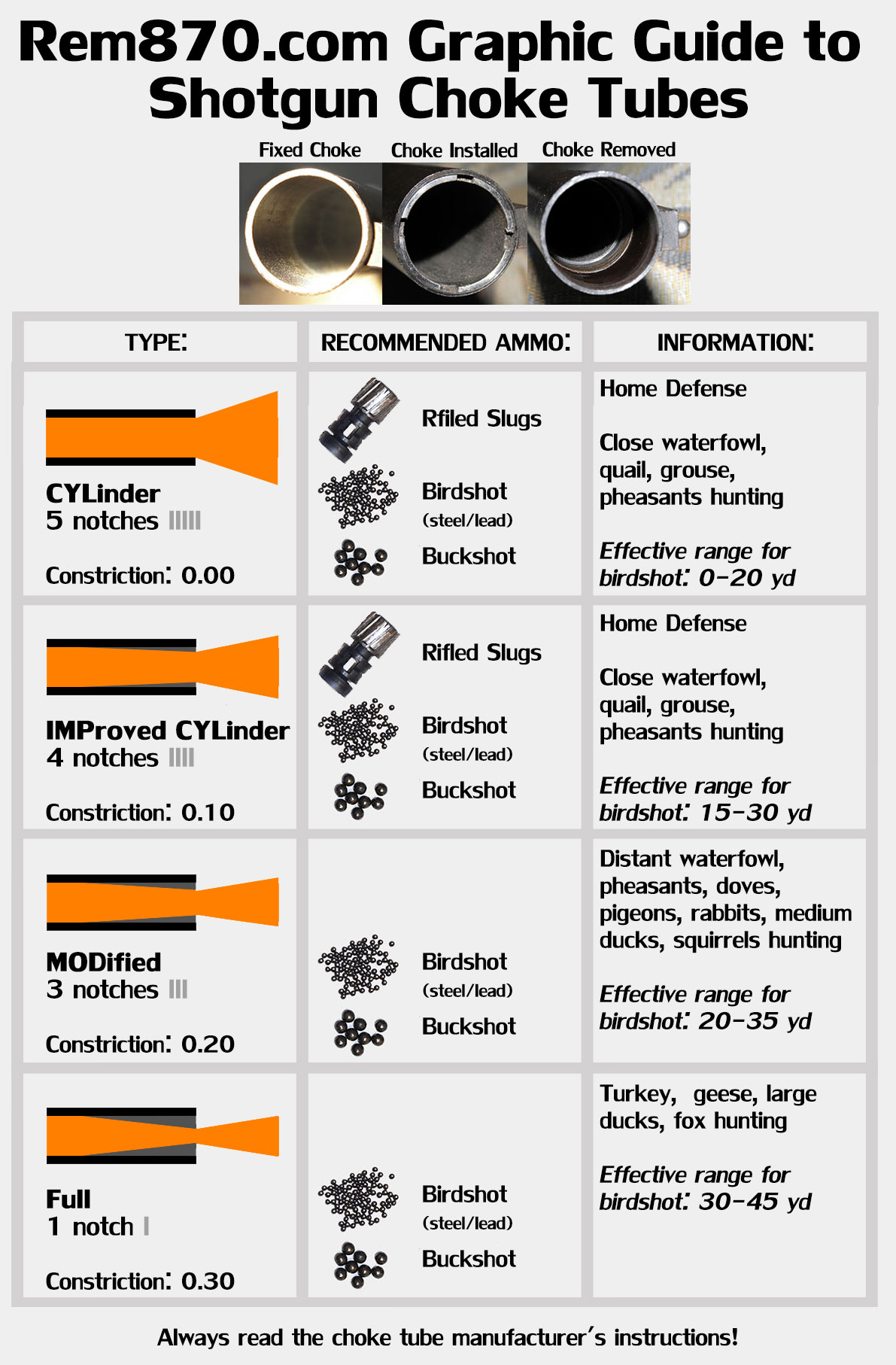
Graphic Guide to Shotgun Choke Tubes
Threading a Shotgun Barrel for Choke Tubes
Owner decided to thread the original 20″ barrel of his Remington 870 for chokes.

Threading a Shotgun Barrel for Choke Tubes

Threading a Shotgun Barrel for Choke Tubes
“Odd or not, I threaded the barrel myself to accept screw in chokes.
Mainly due to the fact that when I checked the old barrel, I found that the muzzle was heavily worn and was actually a NEGATIVE choke rather than the cylinder bore the barrel was marked for.
It was the original 20″ barrel to the gun. Remington confirmed that when I was checking the serial number info on the phone with them by the date code that was on the barrel was in fact a December 89 code.
I admit that I threaded it to Mossberg/Winchester/weatherby style chokes due to being less expensive and easy to find. ”
Recommended Product:
 Get Rem-choke, Win-choke or Tru-choke Style Tooling |
Get Rem-choke, Win-choke or Tru-choke style tooling on Brownells |
Remington Choke Tube Upgrade Kit, 12-Gauge
If you own a Remington 12-gauge shotgun, then you are probably interested in more choke tubes, so you can shape how your shots are going to spread after they leave the bore. The importance of adding a choke tube to a shotgun is so you can add more constriction to your shots. Otherwise, the shots will just spread wide as soon as they leave the bore and this will make it very difficult to aim at small targets that are in your line of fire. To install a choke tube into the bore of your shotgun’s barrel, you need the right choke tubes and installation tools in order to make sure that it is done right.
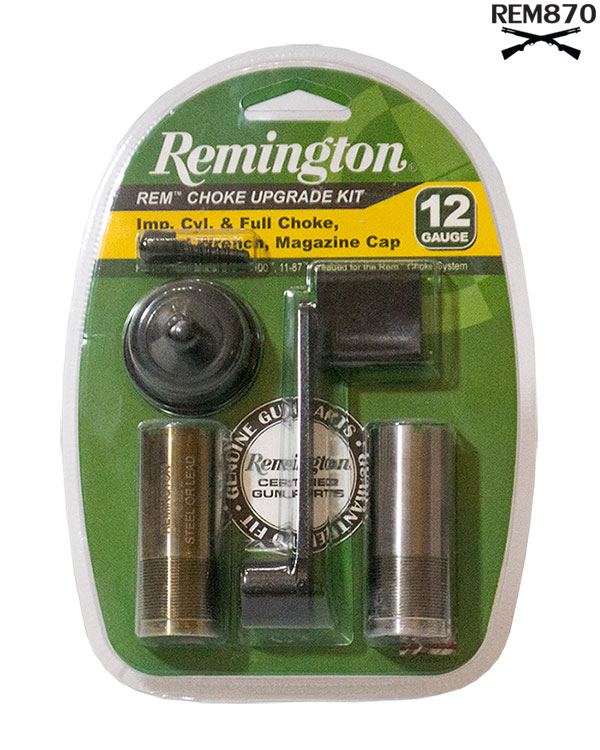
Remington Choke Tube Upgrade Kit, 12-Gauge
The only choke that you receive with Remington 870 Combo is a Modified Choke. The Remington Choke Tube Upgrade Kit is what you will need in this case. You will receive Improved Cylinder and Full chokes. All the parts in the upgrade kit are made of authentic Remington parts that were manufactured at their American factory. You can use either of the two choke tubes in the kit to upgrade your Remington 870, 11-87 or 1100 shotguns. The different sized choke tubes included in the kit will allow Remington owners to do all kinds of shooting. Whether you want to hunt woodcock or rabbit, there is a suitable choke in the kit for any shooter. This kit is also suitable for competitive shooters. You could go with the less constricted choke tube that spreads your shots wider or you can go with the more constricted choke tube which keeps your shots tighter and closer together.
To easily swap parts, the upgrade kit includes a swivel stud and magazine cap. You’ll also receive a choke tube speed wrench which will allow you to change the choke tube a lot faster. This kit literally has everything you will need to change your choke tube within a short amount of time.
The price of the Remington Choke Tube Upgrade Kit is $41.55 and can be purchased at most retail stores that sell sporting goods. You can purchase choke tube upgrade kit or needed chokes separately.
New Choke Tubes for Remington 870: Breecher and Buckshot
2 new interesting chokes from Carlson’s company which is well known for shotgun owners. This company manufactures barrels for Remington 870.
I didn’t have a chance to test them, so if you have any info, please leave a comment.
Carlson’s Tactical Muzzle Brake choke tube
From manufacturer:
The New Carlson’s Tactical Muzzle Brake choke tube features a porting designed to reduce recoil significantly. This new choke tube is manufactured from 17-4 Heat Treated Stainless Steel in your choice of either Cylinder or Extra Full constriction. The Cylinder Choke Tube may be used with ALL shot shells including Lead, Steel, Hevi-Shot, and even slugs! The Extra Full choke tube can be used with all Hevi-Shot and lead loads (but is not to be used with slugs and cannot be used with any Steel shot larger than #2 or with any Steel shot faster than 1550FPS). The Extra Full constriction is also an excellent choice for hunters using larger shot sizes for coyotes, wild hogs and deer. The NEW Tactical Choke Tube has a head that extends approximately 2.75” beyond the end of the barrel and features a matte black finish. The addition of this new choke will not only make any ordinary shotgun look extraordinary, but also significantly reduce recoil allowing for better control of your firearm and quicker follow-up shots. Perfect for Law Enforcement or Home Defense. These chokes are proudly made in the USA and feature Carlson’s lifetime warranty.
More information: https://alnk.to/3cm6KnQ

Carlson’s Tactical Muzzle Brake choke tube
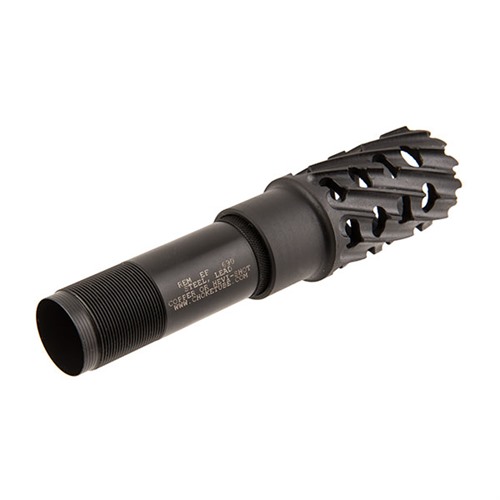
Carlson’s Tactical Muzzle Brake choke tube

Carlson’s Tactical Muzzle Brake choke tube
Carlson’s Remington Ported Buckshot Choke Tube
From manufacturer:
The Remington ported buckshot choke tube is designed to give you tight patterns downrange with 00 & 000 buckshot. This choke is ported to reduce recoil and muzzle jump that tend to go hand in hand with these large loads. This choke features a constriction designed specifically to optimize patterns with large and small loads alike. This choke will extended about 1” out of the barrel and has a black finish. Machined out of 17-4 heat treated material this choke can be used with Lead, Steel, and Hevi-Shot loads. This choke cannot be used with any Steel Shot larger than BB or with any Steel shot faster than 1550 FPS.
More information: https://alnk.to/3cm6KnQ

Carlson’s Remington Ported Buckshot Choke Tube
12-Gauge 3-Gun Remington Choke Tube Set
The Brownells 12-Gauge 3-Gun Remington Choke Tube Set is designed specifically for all 12-gauge Remington pump-action and semi-auto shotguns. This particular choke tube set is suitable for 3-Gun competitions because it gives users the ability to choose which choke tube they want for a given stage. The choke tubes included in this set are a modified choke tube, an improved cylinder choke tube, and a full choke tube.

Shooting Remington 870 with Extended Choke
This will give you the ability to shoot everything from a steel target at a far distance to a clay pigeon moving quickly through the air. All 3 tubes that come in this choke tube set were crafted out of 1704 stainless steel. They were each designed to provide users with tighter shooting patterns that are a lot denser than what you would find with traditional choke tubes. This helps increase your accuracy when shooting at targets within a smaller radius.
The end of each choke tube has been knurled in a way that allows users to quickly remove it so they can add a new one to their weapon. The size and constriction of each choke tube have been marked with a laser on their body and end. That way, you can easily check on which choke tube you are looking at without having to guess on its size. If you’re using rifled slugs, regular slugs, or sabots, make sure you are not using a choke that has a tight constriction. An improved cylinder would be the tightest that you could use with them. Remember that the type of shells you are using in your Remington shotgun should determine which choke tube you use. Some brands of ammunition will create patterns that differ from other brands, even if you’re using the same exact choke tube.
Anyone who purchases the Brownells 12-Gauge 3-Gun Remington Choke Tube Set will receive a lifetime warranty with their order. The price of this 3-Gun Choke Tube Set is $89.99 at Brownells.com. Each choke tube that comes in the set was made in the United States. This ensures that you are getting a quality product that will last you for a very long time. Also, you don’t necessarily have to be a competition shooter in order to enjoy this choke tube set. You could be a hunter and find the convenience of being able to quickly change your choke tube to be an asset in a many situations.
Here is test results. As you can see, extended choke gives better and more predictable results:

Improved Cylinder Choke Test

Modified Choke Test

Full Choke Test
That is especially important for competitive shooters which have penalty targets on stages. This set is highly recommended. It makes changes easier and faster and gives shooter more stable results.
Extended chokes are awesome and highly recommended!
P.S.:There are also sets available for Browning Invector / Winchester and Benelli.
Recommended Product:
 |
Get 12-Gauge 3-Gun Remington Choke Tube Set on Brownells |
Where to buy chokes
It is easy to find chokes for sale. I recommend Brownelss because they have wide selection of chokes for different shotguns, good prices, ship orders fast.
Shotgun Chokes for Remington, Benelli, Beretta, Mossberg, Ruger, Browning, Stoeger
Understanding Shotgun Chokes – Video:
Related Post:
10 Steps to Upgrade Your Remington 870 Express to Police Version
10 Must Have Upgrades for Your Remington 870 Shotgun
Magazine Extensions for Remington 870 Shotgun (Nordic Components, Choate, TacStar, Remington, ATI)
7 Remington 870 Upgrade Ideas for Less Than $20
Support Author of the Rem870.com
You can help using Patreon website (I have added several additional levels of help but you can choose any of them):
https://www.patreon.com/rem870


Very good informative info for us newbies!
I’m glad it was useful for you.
I have a Remington 870 express super magnum with a 26 inch vent rib barrel with a modified choke. Can I shoot slugs out of it through the modified choke or do i have to get a Cylinder or Improved Cylinder choke to shoot slugs out of?
You can shoot slugs thru modified choke tubes but gun companies needed to sell barrels and tubes so it’s not suggested. My cousins shoot slugs thru the full with no problems. It’s the only gun hee can afford. Hunts deer, birds, and rabbit with his 12 gauge full choke vent rib.
I shoot rifled slugs out of my modified choke every deer season. Just don’t shoot sabot slugs and you’ll be fine.
Hi Thanks for the written and illustrated details of 12G shotgun types. A Very Good site.
I am looking to purchase a Baretta 56E ejector with 26 inch barells, ejector, which I think is quite rare. On querying I was told by the vendor that it was factory made. I wonder?.
Additionally, I live in Australia, and am looking for a spare parts supplier in U.S. A. for firing pins and springs for 12G Bernadelli Hammer gun Model 192 Field, side by side, and a fore-grip iron which attaches the fore-grip to the fore-grip timber, the underside of the barrel and slides in to the underside of the block for a 12G, ejector, U/O Baikal Model IZH 27.
Would like to hear from any fellow hunters in USA or Canada, or anywhere for that matter.
gregazz@bigpond.net.au
Thanks for the detailed info on the different types of chokes. You saved my wallet and shoulder.
You are more than welcome!
Man thanks for the info help me a lot
You are welcome!
If I want to shoot steel shot in my older SKB 12 ga. should I use a modified choke rather that a full choke.
Definitely!
Steel does not compress like lead – additionally, larger shot size is used compared to lead for the same applications. What this means is that it can physically ‘spread’ the diameter of the choke and even split the barrel. Your older SKB has beautiful thin roto-forged barrels that can be damaged by shooting steel shot through it. Best to avoid steel shot altogether – but it might be alright to shoot in an improved cylinder.
If you have screw-in chokes, there are lengthened chokes that have the constriction not in the part of the choke that is adjacent to the threads, but rather outside the barrel. If the steel shot spreads the choke, you can replace the choke instead of having loose barrel threads.
Modern guns are generally compatible with steel shot, but the choke is one size more effective. A lead Modified gives an Improved Modified pattern with steel shot.
I just bought a Hawthorn Viking 12 G with a full choke barrel. Will shooting #6 steel shot hurt the barrel?
I’m just getting into 5-stand, from the 16-yard station of course, being a newbie. I tried an improved modified choke with my 12-gauge but only shot 12 for 25 using #7-1/2 shot. Not bad perhaps for a beginner but I’d already shot 19 for 25 with a full choked 20-gauge the week before. I decided to shoot one more round but switched to my Remington Browning-pattern “The Sportsman” circa 1947 with a full fixed choke and with the same 1 oz, #7-1/2 shot and scored a 22 for 25. Puzzling as the more open chokes are supposed to be superior for trap and skeet but that hasn’t been my experience.
In any event thanks for the article. It is informative and it may turn out the old Sportsman simply shoots to my miss. BTW, you may want to edit the first paragraph changing ‘shogun’ to ‘shotgun’ in three places. It happens to the best…
Thanks, Michael! Fixed.
You’re welcome! Question: are there specialty chokes that produce a flat band, i.e. spreads the pattern on either the horizontal or vertical axis depending on how it is set up? Thanks!
Yes, there is the Gator Shotgun Spreader choke that spreads the pattern on horizontal axis. But I didn’t have a chance to test it.
great info on here
Thank you! This is very good info for all of us that are new to shotguns.
Thank you for the information , Is there a Turkey choke ?
I own a Remington 870 20 gauge express with screw in choke at the end of the barrel. I have three screw in chokes improved, modified and full. May I remove the choke tube so I can have a cylinder choke or will firing the gun damage the threads where the choke tubes screw into?
Yes, shooting without choke will damage the threads.
I have a Rem 870 Compact 20 gauge with a 4 slotted choke which I cannot unscrew. Do these chokes unscrew counterclockwise? My intention is for defense with large shot and slugs that may be steel as well as lead, so the most suited choke is what I want, including a rifled possibility. The seller told me his daughter only fired 3 shots through this gun. It truly is in new condition. Could the choke be seized for some reason? I have not fired this gun yet. Please advise me with recommendations. Thanks.
Does it normally take a great deal of effort to unscrew a choke?
Usually, no. But it is recommended to unscrew and clean/lube chokes regularly.
New to turkey hunting, I bought a used NEF 12 GA single shot with a full choke. Will shooting steel through it damage the barrel like it would with the older SKB? And would it be good to get a gunsmith to install a turkey choke ?
Thanks for all the info here!
I have two Mossberg 500 shotguns. One with a 28 inch barrel with a modified choke and the other with a 26 inch barrel with an IMP cylinder. Which should I keep for duck?
Great article by the way. Thanks a bunch.
28 inch barrel with Modified choke is better for duck. Some hunters even use Full choke.
28″ modified for sure. I got the same gun.
the moidified will be best and a lot less frustrating until you train your brain – fewer misses.
I just bought a shotgun and it’s a steep freakin learning curve! Had no idea all the variations, etc. Really fascinating. This is the best, most succinct explanation of chokes that I’ve found. I finally get it!
New hunter which choke would u recommend for goose hunting with steel shot ?
Hi,
I have an L.C. Smith but nothing on the barrels tells
what are the chokes. I have a “factory letter” which
does not address the question.
The ID’s are RT bbl = .715
Lt bbl= .685
Can you tell what I have?
Thanks,
Scott
Great, informative article. But, I do have a noob question. I recently purchased a Remington 870 Tactical. It appears to have just the Cylinder Bore Choke (no visible choke inserts of any kind). If this is true, my question would be, in order to install a choke (i’d like to install a Breecher Muzzle Break on it – because they look cool, and in case in need to pop someone in the forehead with it……). My assumption is that I’ll need to replace the barrel first, but can you let me know what I’ll need to do??
Who came up with the Bovine Scatology about shooting slugs through a choke being dangerous?
Both the Breneke Slug and the later Foster Slug were specifically designed to be fired through a choke to enable people to use their trusty shotgun to hunt deer and other large game. As this article accurately states, even the tightest Turkey Choke has only 0.045 inch restriction. The nominal caliber of a 12 gauge is 0.729 inches and most slugs have a body diameter of 0.690
inches with the external “rifling” keeping the sub caliber projectile centered.. Lead has a compressive strength of only 2,500 psi and SAAMI spec shotgun barrels are rated for 10,000 psi to 14,500 psi depending on exact chambering. Furthermore; the hollow core of a Breneke or Foster slug enables the slug to compress. The actual forces exerted by a slug passing though even a full choke are no greater than the inertial forces exerted on a column of birdshot passing through a choke.
A slug will go through a full choke like crap from a goose.
That was my understanding also, but I have heard it both ways over several decades, and thus am still interested in getting a definitive answer on this question. This article has made me so curious I’ve tried looking up my volume of “Shotguns” by Elmer Keith, to see if there’s anything stated in there since it’s been several years since I read it last. while I understand that steel shot and new manufacturing methods can make a big difference in these questions never the less I would consider him to be a definitive answer.
Hi,guys
My name Tanya
I just want to buy some full choke for my Remington 870 12Ga
Someone’s got any idea where I can get it and how much.
Thank you so much
for a slug or 00buck is it fine to use the full choke thank you
It is better to use Cylyinder or Improved Cylinder with most of the slugs.
Is a full choke available for the 20 gauge 870? I’ve looked at multiple places and have yet to find one.
Yes, available on Brownells: http://bit.ly/2N8vvaD
Wow, thanks for replying so rapidly! Buying it now.
2 Remington 20 ga full chokes available at the Canadian Tire store at Emerald Hills Mall in Sherwood Park Alberta. SKU 175-0634-6 at $29.99 CAD each.
Thanks! I ordered one from Brownell, $20.94 USD including shipping.
Great deal. You have the best economy in the world.
I don’t get it, my father’s been hunting with a Remington 20 gauge model 11 were they barrel comes from the factory full, it says right on the barrel full, he has been shooting 20 gauge slugs through it as long as I can remember with no problems, barrel still looks fine
its good to see the learning and some one that knows to teach I was fortunate and grew up in the sporting world started shooting very young but with people that were very knowledgeable about rifles and shot guns .its all good but I was always taught safety gun barrels right direction etc.used to push for duck hunters the father from the city would bring his kid and that’s the one you had to watch
Thank you so much for the information on the choke information. It was very helpful!
This is a great article – THANKS from another newbie..
I recently bought a Tavor TS12 semi auto and am curious about several things:
1. It comes with Modified choke installed and Improved cylinder in the box. Is it OK to shoot rifled lead slugs in the modified configuration or should I plan to switch it out when I intend to do so? Obviously it is brand new and I was hoping to try several different kinds of loads during a trip to the range, but switching in the middle makes me worry about fouling the threads etc. What are your thoughts?
2. Ammo has been HARD TO ACQUIRE and some of what I did find was steel shot (Winchester #2 and #4 shot, not #2/4 Buck, they are apparently different). It is a modern weapon but do you think steel shot is harmful to the barrel or not?
3. Can you comment on the relative merits of cylindrical red dot sights vs open holographic ones? Also, how high up the range of offerings does one need go to get a good quality durable sight? The ones in videos are always $500+ which seem a bit steep and perhaps unnecessary for someone like me (not spending days outside hunting in adverse environments).
Thanks very much for this informative article and any answers you can provide to my questions.
Should I get an improved cylinder choke for bird shot and slug for remington 870 short barrel? It might be a youth gun. It’s my wife’s.
very good article i have a 870 super mag , plan on hunting coyotes soon any recomendations on choke tubes and shot